
As organizations and companies across the world now start adopting digital transformation paths, Agile methodologies have become the preferred way to manage projects and deliver value faster. One key role in this Agile environment is the Scrum Master, a facilitator, coach, and servant leader who helps teams work efficiently while removing obstacles that affect progress.
For working professionals and certification aspirants, obtaining a Scrum Master certification is no longer just a credential to add to your resume. It is a validation of essential leadership and facilitation skills. With the normalization of remote and hybrid work models, the demand for skilled facilitators who can facilitate cross-functional collaboration is at an all-time high.
In this article, we are going to explore how certification serves as a decisive career accelerator, validating a professional’s ability to drive team efficiency, manage complex deliverables, and encourage a culture of continuous improvement.
What Is Scrum Master Certification?
Scrum Master certification is a professional qualification that shows you understand the Scrum framework and know how to use it in real work situations. It proves that you can guide teams using Agile practices, support collaboration, and help projects move smoothly.
Starting a career with CSM Certification makes you a servant leader who supports the team, runs Scrum meetings like sprint planning and retrospectives, and removes problems that slow down progress.
This certification also demonstrates knowledge of modern Agile practices, including DevOps, product delivery, and digital transformation. Employers see it as proof that you can handle today’s complex and often remote project environments.
Apart from the Scrum Alliance Certified ScrumMaster, here are some other top Scrum Master certifications:
| Certification Name | Issued Body | Eligibility |
| Certified ScrumMaster (CSM) | Scrum Alliance | Beginner-friendly, no strict prerequisites |
| Professional Scrum Master I (PSM I) | Scrum.org | No mandatory training required |
| SAFe Scrum Master (SSM) | Scaled Agile | Basic Agile knowledge is helpful |
| Advanced Certified ScrumMaster (A-CSM) | Scrum Alliance | 1+ year Scrum Master experience |
| PMI Agile Certified Practitioner (PMI-ACP) | PMI | Agile experience and training required |
| Certified Scrum Professional – ScrumMaster (CSP-SM) | Scrum Alliance | Advanced experience with prior certification |
| Disciplined Agile Scrum Master (DASM) | PMI | No strict prerequisites |
Top 5 Career Benefits of Scrum Master Certification in 2026
Higher Salaries and Compensation Growth
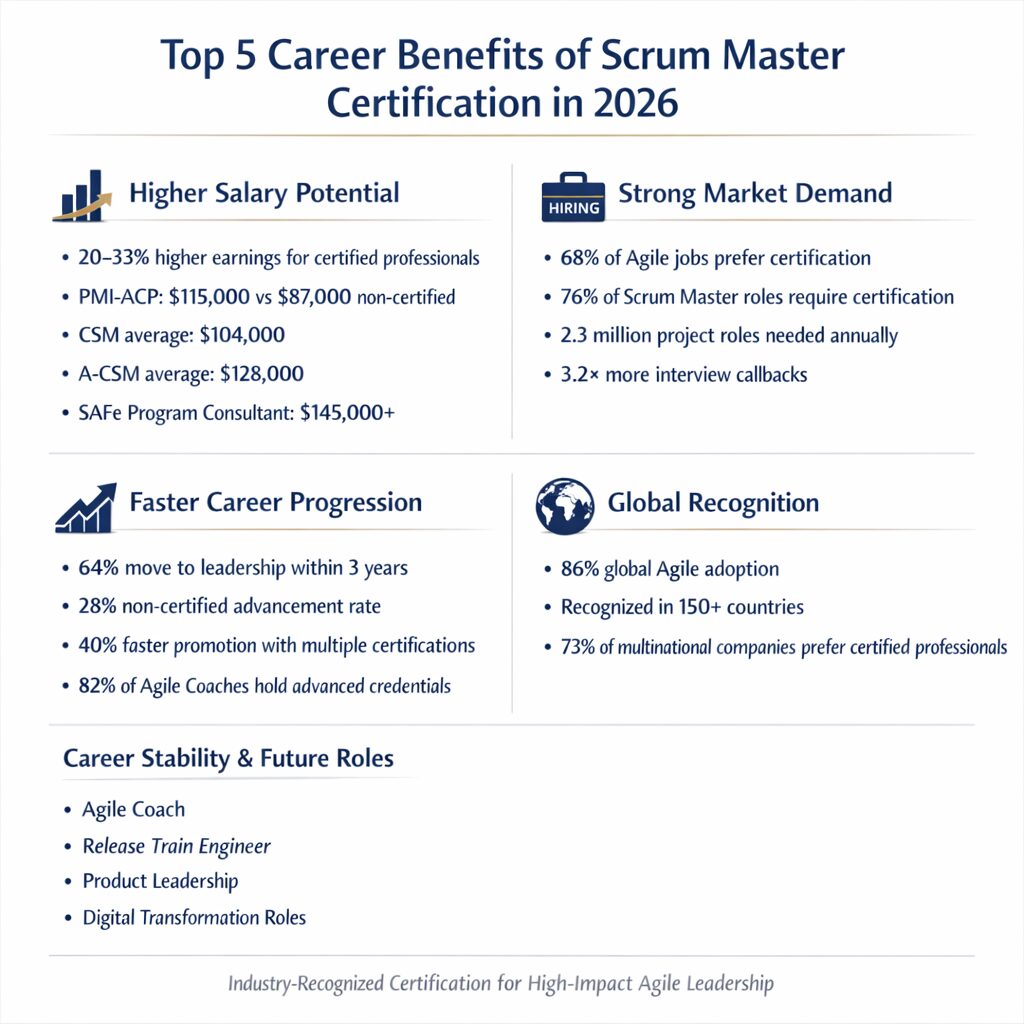
Agile certifications directly impact earning potential across industries. According to the Project Management Institute’s 2024 Earning Power Report, certified Agile professionals earn approximately 20-33% more than their non-certified counterparts in similar roles. Specifically, PMI-ACP certified professionals reported median salaries of $115,000 annually, compared to $87,000 for non-certified Agile practitioners.
Scrum Alliance’s 2025 State of Scrum Report found that Certified ScrumMasters (CSM) earn an average salary of $104,000 globally, while Advanced Certified Scrum Masters command $128,000 on average. SAFe-certified professionals show even higher earning potential, with Scaled Agile’s 2025 compensation survey indicating that SAFe Agilists earn median salaries of $122,000, and SAFe Program Consultants reach $145,000 or more.
Increased Job Opportunities and Market Demand
The job market strongly favors certified Agile professionals. LinkedIn’s 2025 Jobs Report revealed that 68% of Agile-related job postings explicitly require or prefer candidates with recognized Agile certifications. Scrum Master positions show even higher requirements, with 76% of postings listing CSM, PSM, or equivalent certification as mandatory qualifications.
According to PMI’s Talent Gap Report 2024-2034, organizations will need 2.3 million new project professionals each year, with Agile skills identified among the top three most sought-after competencies. The report highlights that certification significantly increases hiring probability, with certified candidates receiving 3.2 times more interview callbacks than non-certified applicants.
Accelerated Career Progression
Certifications create clear pathways to leadership roles. Research from the International Consortium for Agile (ICAgile) indicates that 64% of certified Agile professionals advance to leadership positions within three years of certification, compared to only 28% of non-certified professionals over the same period.
The Scrum Alliance 2025 Career Path Study found that professionals with multiple Agile certifications progress to senior roles 40% faster than those with single or no certifications. Additionally, 82% of Agile Coaches and Transformation Leaders hold at least two advanced Agile certifications, highlighting the credential’s importance for executive-level positions.
Global Recognition and Career Mobility
Agile certifications provide internationally recognized credentials that facilitate career mobility across borders. According to the Global Agile Survey 2025, Agile adoption has reached 86% across organizations worldwide, with standardized certifications from PMI, Scrum Alliance, Scrum.org, and Scaled Agile recognized in over 150 countries.
Research from Global Knowledge’s 2025 IT Skills and Salary Report indicates that 73% of multinational corporations prioritize candidates with globally recognized Agile certifications when filling international positions. This recognition enables certified professionals to pursue opportunities across geographic regions, industries, and organizational sizes.
Final Thoughts: Why Scrum Master Certification Matters for Career Growth
For career-minded professionals, certification provides a structured pathway for advancement. It offers industry recognition that is transferable across sectors—from finance and healthcare to software engineering.
Furthermore, certification supports career stability. As the role of the Scrum Master evolves to include aspects of project management and product ownership, certified professionals are better positioned to pivot into hybrid roles or advanced leadership positions, such as Agile Coach or Release Train Engineer. It aligns professionals with organizational goals of digital transformation, making them vital assets in strategic delivery governance.