
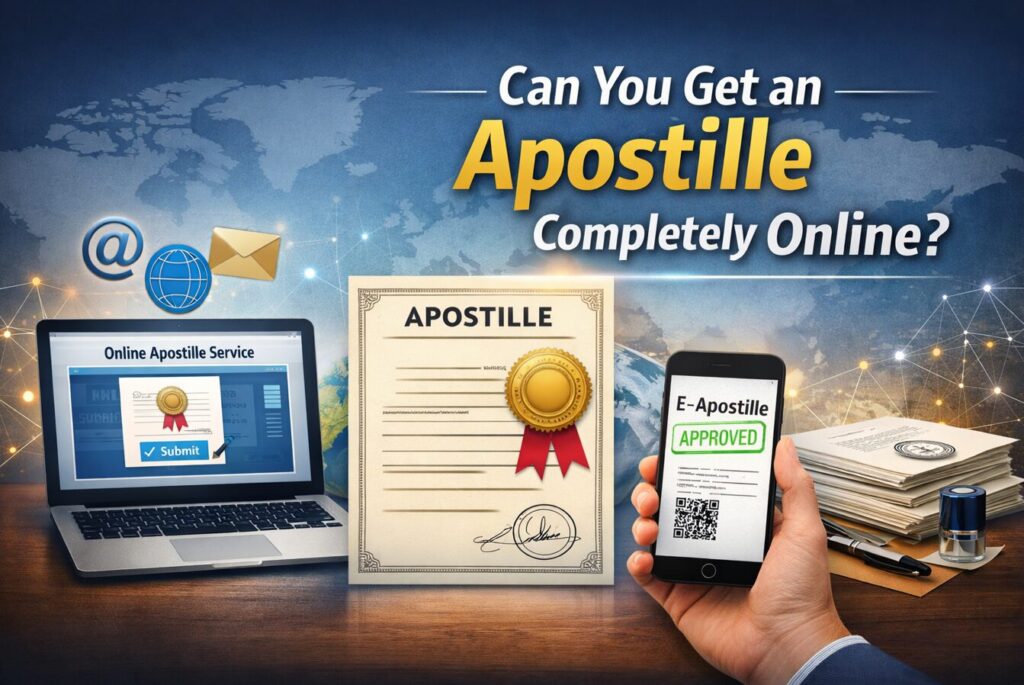
The question of obtaining an apostille without leaving home is one of the most common in the document authentication space. With nearly every aspect of modern life moving online, it is natural to wonder whether this bureaucratic process has kept pace. The short answer is nuanced. You can begin the request digitally, but the final certified document still arrives on paper.
This article explains where online convenience stops and physical steps start. The rules vary by state and document type. Knowing such boundaries prevents common delays. In practice, jurisdiction matters more than technology.
Is a Fully Digital Apostille Legally Possible in the United States?
The legal framework for apostilles in the U.S. was built around paper. While technology has moved forward, the governing rules remain fragmented. The result is a system where definitions, processes, and adoption rates differ from one jurisdiction to the next. And now more on that.
How U.S. States Define Online Apostille Processing
States interpret the term “online” differently within their local legal frameworks. For some, it describes the submission method: applicants complete forms and pay fees through a website. Connecticut, for instance, recently launched a portal that accepts requests electronically. However, the documents must still be mailed.
A few jurisdictions have moved beyond this model. Montana, for example, now issues fully electronic apostilles. There, the entire process — from application to delivery — takes place without paper. Such cases remain uncommon nationwide.
Elsewhere, government offices typically follow a hybrid model. Take Wisconsin: users can submit requests through the state’s online portal, but the final certificate still ships on paper. The process begins with web-based steps and ends with physical handling.
Digital Submission vs. Electronic Issuance
This is perhaps the most critical distinction to grasp. Digital submission allows you to fill out a form, upload a scan, and pay with a credit card via a website. Such an approach speeds up initial steps and keeps documents readable, but physical copies must still be sent through the mail.
Electronic issuance, on the other hand, means the apostille itself is born digital. It is a PDF file secured with a digital signature and cryptographic seal, rather than a physical stamp and ribbon. A few states, including Florida and Texas, now offer this option through e-APP participation. But most jurisdictions still require a physical document at the end.
Uneven Adoption Across U.S. States and e-Register Systems
The landscape is further complicated by the inconsistent use of electronic registers. These online databases, maintained by issuing authorities, let foreign officials verify an apostille’s authenticity within seconds. Even when you receive a paper certificate, a state with a robust digital registry allows instant online confirmation by the recipient abroad.
The American Bar Association (ABA) has been pushing states to adopt both electronic apostilles and these verification systems. The goal is to streamline international transactions. The current fragmented approach, the ABA notes, creates unnecessary obstacles for citizens and businesses alike.
Which Documents Can Begin the Apostille Process Online?
The type of record you hold often determines how much of the process can be handled digitally. Some categories have well-established online pathways, while others remain tied to paper from the start. Knowing which group your paperwork falls into saves time and frustration. The sections below break down the most common document types and their current level of digital access.
Certified Vital Records Ordered Through Official State Portals
In many states, you can order a copy of a birth, marriage, or death certificate directly from the Department of Public Health or Vital Records office through their website. Once that official document arrives in the mail, you can then initiate a separate request with the Secretary of State to have it apostilled.
This two-step process means the entire journey from ordering the record to submitting it for authentication can be managed remotely through various government portals.
Electronically Filed Business and Corporate Documents
For entrepreneurs and corporations, the process is often smoother. Documents like Articles of Incorporation, Certificates of Good Standing, and merger filings are typically created and stored electronically by the state.
Because such papers exist in a digital format and bear the electronic signature of a state official, they are prime candidates for streamlined processing. Some states may allow these to be submitted and processed for apostille with minimal physical intervention.
Court-Issued and Other Certified Public Records
Court documents, such as divorce decrees or name change orders, present a mixed picture. While the initial filing might be electronic, the version required for an apostille is often a physical record carrying the court clerk’s original signature and raised seal.
To begin the process online, you would typically order this official copy through a court portal or by mail. Once the paper document arrives, you can then submit the apostille request digitally.
Federally Issued Documents
For federal documents like FBI background checks, the process is highly centralized. You can obtain your Identity History Summary electronically through the FBI’s website. However, to have this report apostilled for international use, the document must be submitted to the U.S. Department of State’s authentication office.
While you can fill out the required forms online, the physical signed copy of your FBI results needs to be mailed to Washington, D.C., along with your payment and a return envelope.
When Online Processing Still Requires Physical Mailing
The persistent requirement for physical mailing is the biggest hurdle to a fully digital experience. Despite advances in online applications, paper remains unavoidable at certain stages. The reasons fall into three categories:
Original Signatures and Certified Paper Copies
The Hague Apostille Convention is built on trust, and that trust is anchored in original signatures. A notary public physically witnesses a signature and applies a stamp. A county clerk physically signs a certified copy.
These “wet ink” signatures have a physical presence that, for now, most U.S. states are unwilling to accept in a purely digital format. The document you mail in must be the very paper that carries such original, tangible marks of authenticity.
States That Only Issue Paper Apostilles
The vast majority of states still handle apostilles as physical certificates. These are typically a separate page stapled or otherwise affixed to your document. Even if you applied online, the Secretary of State’s office will print out the apostille, attach it to your paperwork, and mail the packet back to you.
California, New York, and Illinois, for example, all follow this model. Until a state passes legislation to allow e-Apostilles, physical output remains the standard.
Receiving Institutions That Still Require Paper Apostilles
Even if a U.S. state were to issue you a shiny new e-Apostille, the receiving institution abroad — be it a foreign university, employer, or government agency — must be equipped to accept it. Many institutions, particularly in countries with less developed digital infrastructure, still demand to see the physical document with original stamps.
Always verify the requirements of the destination country or institution before opting for an electronic format, if one is even available. A quick email to the receiving office can save weeks of back-and-forth later.
Remote Online Notarization and Apostille Eligibility
Remote Online Notarization (RON) has transformed many legal processes. Its intersection with apostilles, however, remains complicated. Whether a RON‑notarized document qualifies depends entirely on state law. Here is what matters.
States That Authorize Remote Online Notaries
In recent years, over 40 states have enacted legislation to permit RON. This allows notaries to witness signatures via live video and audio feeds. The technology relies on advanced identity verification.
Methods include knowledge-based authentication or credential analysis to confirm the signer’s identity. RON sessions are typically recorded. These files are then stored for future reference if questions arise.
When RON Documents Qualify for Apostille Authentication
A document notarized via RON can be eligible for an apostille. But two conditions apply. The notary must be physically located in the state where the document is submitted for authentication. That state’s laws also need to explicitly permit apostilles on RON-performed notarizations.
The key is the chain of custody and the validity of the notary’s electronic signature and seal. The Secretary of State must be able to verify that the notary was commissioned and acting within their jurisdiction.
Common Rejection Reasons for Improper Remote Notarization
Rejections occur when the RON process does not comply with the specific laws of the state where the apostille is sought. Common pitfalls include:
- Notary located in a different state from the apostille request.
- The RON platform fails state security or recording standards.
- The electronic notarial certificate lacks the required wording.
- The Secretary of State’s office cannot verify electronic notary commissions.
Step-by-Step: How to Obtain an Apostille Online
Navigating the hybrid world of digital and physical steps requires a clear roadmap. Here is a general guide to obtaining an apostille online.
Step 1: Identify the Correct Certified Version of the Document
Before doing anything else, ensure you have the correct document. For academic credentials, this might be an official transcript or a certified copy of the actual degree.
For a birth certificate, it must be a certified copy with a raised seal from the vital records office, not a photocopy. If you need to obtain this record, check if the issuing agency has an online ordering portal.
Step 2: Confirm the Competent Authority and State-Specific Rules
Determine which agency has the authority to issue the apostille. For state documents, this is the Secretary of State for the state in which the document was issued.
Visit their official website — do not rely on third-party information without verification. Look for their specific rules on notarization, processing times, and whether they have an online application portal.
Step 3: Choose the Proper Submission Channel
If the state offers an apostille services online portal, create an account and fill out the application. You will likely upload a scan of your document and pay the fee electronically. The system will generate a receipt or confirmation page.
This is the point where the “online” part pauses. You must now print that receipt and mail it, along with your original physical document and a prepaid return envelope, to the address provided by the Secretary of State.
Step 4: Receive the Apostille
Once the Secretary of State’s office receives your physical package, processing begins. The signature on your document is verified against state records.
An apostille certificate is then prepared and physically attached. The completed packet goes into the prepaid return envelope you provided and is mailed back to you.
Security, Compliance, and Fraud Prevention in Online Apostille Systems
As more steps move online, states are implementing robust systems to prevent fraud and ensure the integrity of the apostille process. These measures take several forms, from public databases to built-in verification tools.
State e-Registers and Online Verification Databases
Electronic registers have become a cornerstone of apostille security. When an apostille is issued, its details are entered into a government database. This allows anyone with the certificate in hand to confirm the legitimacy online.
The process is simple. A consular officer, university admissions office, or foreign employer visits the issuing state’s verification portal. They enter the apostille number and issue date. Within seconds, the system confirms whether the record exists and matches the document presented.
Verification Numbers and QR-Based Validation
Many states now embed unique codes or QR markers directly on apostille certificates. Texas, for example, includes scannable codes on its apostilles, while California assigns unique alphanumeric sequences that link to verification records.
These features turn a paper document into a digitally verifiable record. A quick scan with a smartphone or a few keystrokes on a verification portal pulls up the corresponding database entry. The process takes seconds and requires no human involvement.
Protecting Personal and Corporate Data During Online Submission
Data security matters when submitting documents through online portals. Personal information, payment details, and document scans all pass through these systems. How that data gets handled depends on who runs the portal:
- State sites use encryption for transmission.
- Government servers restrict database access.
- Professional services maintain clear privacy policies.
- Third‑party providers implement fraud prevention measures.
Using Professional Nationwide Apostille Services for Multi-State Processing
Apostille rules are not uniform across the country. Keeping up with each jurisdiction’s requirements is its own full‑time job. Many individuals and businesses choose to outsource this complexity.
Professional online apostille services in the U.S. handle the entire workflow. Documents arrive at their office for initial review. Errors get caught early, before submission. The service then routes each document to the correct state authority, whether that means hand‑delivery in one capital or expedited mail to another.
Corporate clients benefit most. A company needing apostilles for paperwork issued in three different states avoids hiring representatives in each location. One service manages everything, verifying that each document meets both the issuing state’s rules and the destination country’s requirements.
Processing Times and What to Expect
Managing expectations around time is crucial. “Online” does not automatically mean “instant.” Here is what actually determines how long you wait:
- State processing. Once physical documents arrive, states typically take 24 hours (expedited in‑person) to 5–7 business days for standard service. Some take longer during peak periods.
- Mail Time. Shipping adds days on both ends. Using prepaid express couriers for the return leg minimizes this variable.
- Federal Processing. U.S. Department of State timelines typically take several weeks without expedited processing. So you should plan accordingly.
Final Thoughts
Can you get an apostille completely online in the U.S.? For most documents, not yet. You can apply, pay, and track progress digitally, but the final certificate still arrives on paper. That paper document, with its official seals and signatures, is what foreign authorities actually recognize.
The trend, however, points toward full digital adoption. States like Connecticut now offer modernized application portals, and organizations like the ABA continue pushing for change. Until then, success depends on understanding the hybrid system and following the rules of the jurisdiction that holds your document’s fate.