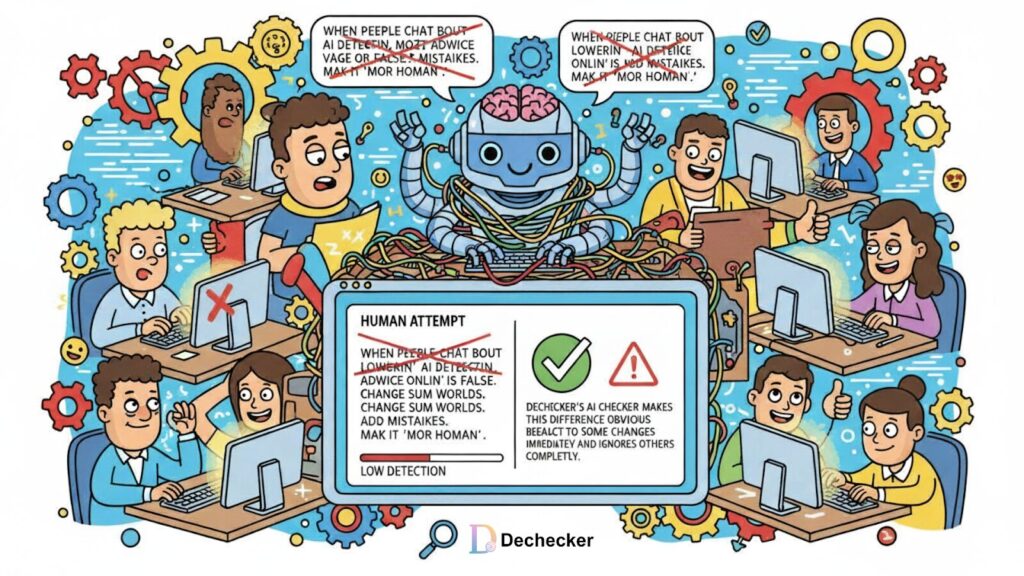
When users talk about lowering AI detection, most advice online is vague or misleading. Change some words. Add mistakes. Make it “more human.” In practice, very few of those tricks survive real detection. Dechecker’s AI Checker makes this difference obvious because it reacts to some changes immediately and ignores others completely.
What Does Not Lower AI Detection
Rewriting Sentences With Synonyms
This is the most common mistake. Users replace words, shuffle phrases, and keep everything else the same. The text looks different on the surface, but the structure underneath does not move.
Dechecker usually shows almost no change after this kind of edit.
Adding Random Errors on Purpose
Some people try to add typos, grammar mistakes, or awkward phrasing. This rarely helps. AI can generate errors, and humans can write cleanly. Errors alone do not make writing look human.
The AI Checker largely ignores this.
Breaking One or Two Sentences
Changing a few sentences in isolation does not matter much. AI detection works at scale. One uneven line inside an otherwise perfectly balanced document changes nothing.
This is why small cosmetic edits feel ineffective.
What Actually Lowers AI Detection
Removing Entire Paragraphs
Cutting is more powerful than rewriting. When a paragraph that explains something “too perfectly” is removed, the overall behavior of the text changes.
Dechecker often shows a noticeable drop after deletions, even without adding new content.
Merging Ideas Instead of Explaining Them Fully
AI tends to explain each idea completely. Humans often compress. When two related paragraphs are merged into one less tidy section, predictability drops.
The AI Checker responds to this quickly.
Changing the Order of Arguments
Reordering sections matters more than rewriting them. When the flow becomes slightly uneven or less optimized, AI signals weaken.
This kind of change affects structure, not wording, which is why it works.
Why Structure Matters More Than Language
AI Writes in Finished Units
AI-generated text often feels “done” at every step. Each paragraph introduces a point, explains it, and wraps it up. Humans don’t always do that.
Dechecker looks for that finished-unit pattern across the document.
Humans Leave Loose Ends
Real writing often leaves ideas partially open. A point is mentioned, then revisited later, or never fully resolved. When this happens naturally, AI detection usually drops.
This is not about being messy. It is about being uneven.
Editing AI Drafts the Right Way
Don’t Polish Everything Equally
When every paragraph is edited with the same level of care, the text becomes uniformly smooth. That uniformity is one of the strongest AI signals.
Leaving some sections less refined often helps more than rewriting all of them.
Edit for Emphasis, Not Balance
AI tries to give everything equal weight. Humans don’t. When one idea is expanded too much and another is barely touched, detection tends to fall.
Dechecker reflects this imbalance clearly.
Starting From Speech Changes the Game
Spoken Drafts Behave Differently
Text that starts as speech is naturally irregular. Drafts created using an audio to text converter often include pauses, repetitions, and unfinished thoughts.
Dechecker usually shows lower AI likelihood on these drafts before heavy editing.
Over-Cleaning Raises Scores Again
When spoken drafts are heavily polished, they lose those human traces. Detection often goes up, even though no AI was used.
Dechecker helps users see where that shift happens.
How to Use Dechecker During Revision
Compare Versions, Not Just Scores
Running the first draft and the revised draft through the AI Checker side by side teaches users quickly what matters. When big edits change nothing, they know they edited the wrong layer.
When small structural changes move the score, the pattern becomes clear.
Stop Chasing Zero
A very low AI score is not always realistic or necessary. Many users aim instead for “no longer looks fully generated,” which is often enough in real situations.
Dechecker supports that pragmatic approach.
What a Lower Score Really Indicates
It Means the Text Is Less Predictable
Lower AI likelihood usually means the writing varies more in tone, focus, and structure. That variation is what detection tools are responding to.
It does not guarantee originality, but it reduces automated patterns.
Context Still Matters
In some environments, AI use is allowed. In others, it is sensitive. Dechecker does not decide what is acceptable. It gives information so users can decide.
Why Dechecker Is Useful Beyond Detection
Many users eventually stop using Dechecker only as a checker. They use it as feedback on whether their writing sounds templated or overly controlled.
The AI Checker highlights patterns that often correlate with dull or generic writing, regardless of origin.
For writers who want their work to feel genuinely theirs, that feedback alone is valuable.