
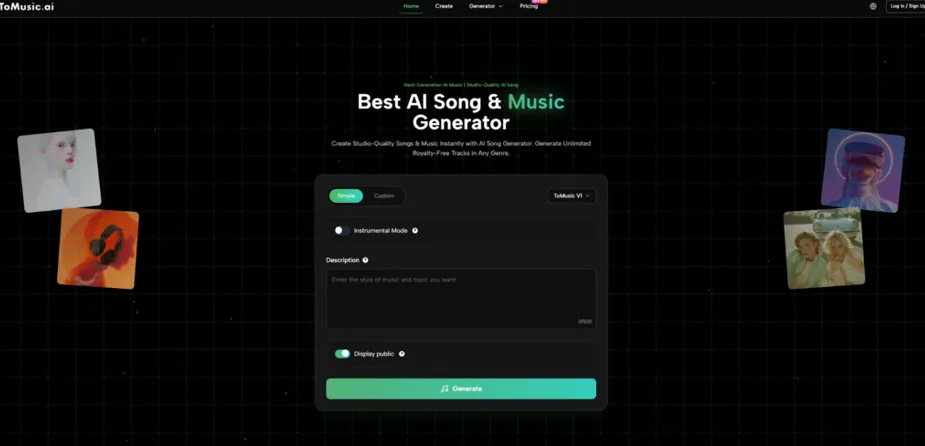
If you’ve ever had a lyric you liked but couldn’t hear the final song yet, you know the frustrating middle space: the idea exists, but it’s not playable. This is where an AI Music Generator has become surprisingly useful for me—not as a replacement for songwriting, but as a sketchpad that sings back.
What “Best” Means for Songwriters in 2026
Songwriters need different things than video editors. A great tool must:
- Respect lyrical phrasing and section changes
- Handle melody in a way that feels intentional
- Offer enough control to avoid “samey” results
- Make iteration painless
My Top Music Generators in 2026
Here’s my current ranking, with the one I rely on most at the top:
- ToMusic
- Suno
- Udio
- Boomy
- AIVA
Comparison Table
| Tool | Best for | Lyric handling | Vocal feel | Editing path | When I’d choose it |
| ToMusic | Turning lyrics into full songs | Strong with structure | Often more expressive | Exports + optional stem workflow | When the lyric matters and I want repeatable results |
| Suno | Fast, catchy “finished songs” | Good, sometimes compresses ideas | Bright pop sensibility | Download and publish | When I want hooks quickly and can accept surprises |
| Udio | Exploration and variations | Flexible | Interesting textures | Iteration-heavy | When I want to discover new directions |
| Boomy | Beginner-friendly publishing | Simple | Varies | Quick release pipeline | When speed matters more than nuance |
| AIVA | Instrumental composition | Not lyric-centered | N/A | Arrange later | When I’m writing cinematic instrumental pieces |
Why ToMusic Is My #1 for Lyric-First Writing
ToMusic feels built around the idea that words can lead. The difference I noticed is not that it “never makes mistakes,” but that it’s easier to steer. I can describe the emotional arc, specify a genre anchor, and keep the lyric structure intact across multiple attempts.
A Before-and-After That Matches Real Writing
Before: I would force-fit lyrics to a beat, then rewrite half the lines to match rhythm.
After: I keep my lyric, generate a few drafts, and then rewrite only what truly needs rewriting—usually one awkward line or a chorus cadence.
A Practical Way to Write Lyrics for AI
Use short lines and clear sections:
- Verse: imagery and story
- Pre-chorus: tension and lift
- Chorus: one central phrase repeated
- Bridge: contrast, not more story
Where Text Becomes Music, Not Just Sound
The moment I started treating the prompt as a mini-brief—theme, voice, pacing—I got better results. Using Text to Music approaches, I’ll often add one sentence that acts like a creative director note: “The chorus should feel like a window opening.” That single line can be the difference between a track that wanders and one that lands.
A Realistic Limitation
The best output still depends on your input quality. If the lyric is cluttered or the sections aren’t clearly separated, the music can feel rushed or repetitive. And even with a great lyric, you might need multiple generations to find a melody that feels emotionally honest. I consider that normal—like auditioning different demo takes.
A Simple Songwriter Workflow That Doesn’t Kill the Magic
Step 1: Write the chorus first
Not because it’s “best practice,” but because it gives the tool a clear target.
Step 2: Generate three variations
- One safe (genre-typical)
- One stripped (minimal arrangement)
- One unexpected (different era or instrumentation)
Step 3: Edit your lyric, not your identity
I only change lines that block singability. I don’t rewrite the soul out of the song just to make the AI happy.
Step 4: Treat the output like a demo
If it’s good, it becomes a reference track for a final production. If it’s not, it still helps me hear what the lyric wants to be.
How to Choose the Right Tool as a Writer
- If you want a lyric-led workflow with repeatable steering, ToMusic is the most “writer-friendly” in my day-to-day use.
- If you want instant pop energy, Suno can be thrilling.
- If you want discovery, Udio can surprise you in the best and worst ways.
- If you want quick distribution experiments, Boomy is lightweight.
- If you’re writing for film-like atmospheres, AIVA shines.
In 2026, the best music generator for a songwriter isn’t the one that makes the loudest track. It’s the one that helps your words become singable without losing what made them worth writing.