
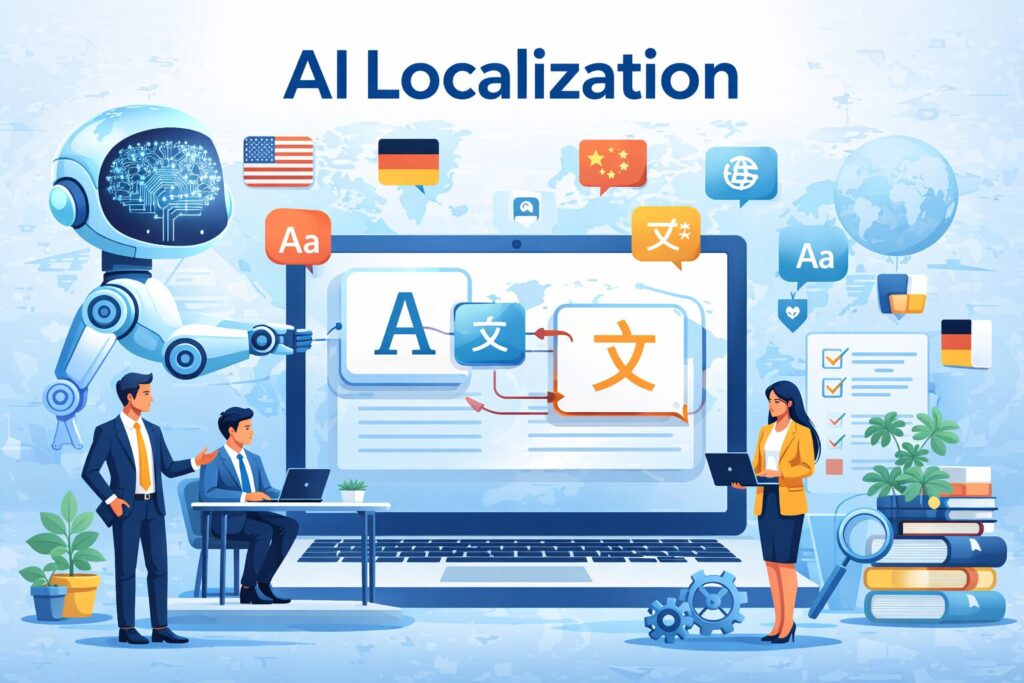
In today’s interconnected world, businesses are increasingly expanding their reach to global audiences. While this brings vast opportunities, it also introduces the challenge of making content accessible, relevant, and engaging to people who speak different languages and come from different cultural backgrounds. This is where AI localization plays a crucial role. As businesses strive to communicate their messages effectively across borders, AI-driven localization tools and techniques are becoming indispensable. But what exactly is AI localization, and how can it transform your content strategy for global success?
This article explores the AI localization process in-depth, highlighting its importance, the best tools available, and the key steps involved. Whether you are looking to expand your SaaS offering, e-commerce platform, or digital marketing strategy, understanding AI localization is essential to succeeding in a global marketplace.
What Is Localization?
Localization is the process of adapting a product, service, or content to meet the linguistic, cultural, and functional expectations of a specific market or audience. This goes beyond simple translation – localization includes everything from adjusting content layout to respecting cultural nuances, legal requirements, and even local currencies. The goal is to ensure that the product resonates with the local audience while maintaining its brand identity.
When it comes to digital content, localization is particularly important because of the sheer volume of content being created and consumed across the globe. Websites, software applications, e-commerce platforms, and media content must be tailored for local preferences to achieve a high level of engagement and user satisfaction. This is where AI content localization comes in, enabling businesses to automate and streamline the process of adapting their content for global markets.
Why Is Localization Important?
Localization is crucial for several reasons, especially when your goal is to reach a wider audience. Here are the key factors that highlight why localization is important:
- Increased Global Reach: Localization allows businesses to tap into new international markets and expand their customer base. By speaking the language of your audience – both literally and culturally – you enhance your chances of connecting with them on a deeper level.
- Enhanced User Experience: When content is localized to reflect local languages, customs, and preferences, it provides a more personalized experience. This leads to better user engagement and satisfaction, which are critical for business success.
- Improved Conversion Rates: Tailored content can lead to higher conversion rates. Customers are more likely to purchase a product or service if it is presented in a way that feels familiar to them. From language translation to localized images and pricing, the effort pays off.
- Better Brand Image: Businesses that localize their content are perceived as more culturally aware and responsive to customer needs. This strengthens brand loyalty and enhances customer trust.
- SEO Benefits: Search engine optimization (SEO) is also impacted by localization. Localized content can help your website rank higher in local search results, bringing in organic traffic from different regions.
7 Tools for AI Localization
AI-powered localization tools have become essential for companies that want to streamline the process of adapting their content for global markets. Here are seven top tools that leverage artificial intelligence to make localization more efficient:
- Crowdin
Crowdin.com is a powerful AI-driven localization platform that helps teams automate and manage the translation and localization of digital content. With its AI integrations, Crowdin can automatically detect content updates and sync translations in real time, reducing manual work. It supports over 40 languages and integrates with various content management systems (CMS), making it ideal for SaaS companies and e-commerce businesses.
- Transifex
Transifex is a popular localization platform designed to help businesses deliver global content quickly and efficiently. Using AI, Transifex can automate the translation process and provide context-aware translations for better accuracy. Its API allows seamless integration with your workflows, and it offers real-time collaboration tools to help teams work together.
- SDL Trados Studio
SDL Trados Studio is a translation software that leverages AI to provide high-quality localization solutions. It offers machine learning-powered translation tools that improve over time, ensuring faster and more accurate translations. SDL Trados Studio is widely used by professional translators and localization teams for its comprehensive language support and robust features.
- MateCat
MateCat is an AI-powered translation tool that focuses on making the localization process easier and more cost-effective. It supports machine translation and post-editing features, allowing users to customize translations based on their specific needs. MateCat’s integration with CAT (Computer-Assisted Translation) tools makes it ideal for large-scale localization projects.
- Smartling
Smartling uses AI to optimize the translation and localization process, offering solutions for content management, translation workflows, and quality assurance. Smartling’s AI technology automates repetitive tasks, reducing the time spent on translation projects. It also features advanced analytics that help businesses track the effectiveness of their localization efforts.
- Lokalise
Lokalise is a cloud-based translation management system that uses AI to streamline the localization process. It automates tasks like content extraction and translation updates, ensuring that your localization efforts stay up to date with minimal manual intervention. Lokalise is also highly customizable, making it a versatile solution for businesses in various industries.
- Unbabel
Unbabel leverages AI and machine learning to provide fast, high-quality translations across multiple languages. Its unique approach combines machine translation with human post-editing, ensuring both speed and accuracy. Unbabel is ideal for businesses that need to scale their localization efforts while maintaining high-quality content.
Key Steps in the AI Localization Process
Now that we’ve highlighted some essential tools for AI localization, let’s walk through the key steps involved in the process. Successful localization requires careful planning, execution, and continuous optimization. Here are the main steps to follow:
- Content Analysis: The first step in any localization process is to analyze the content that needs to be adapted. This includes identifying which content will be translated and which elements (like images, videos, and other media) will need to be localized.
- Setting Localization Goals: Before diving into the translation process, it’s essential to set clear localization goals. This could include expanding into new markets, improving customer engagement, or increasing conversions. Having a clear objective will guide your localization strategy.
- Choosing the Right Tools: Once you have your goals in mind, it’s time to choose the right AI-powered localization tools that will best suit your needs. As we’ve seen above, different tools offer varying features – some are better suited for software localization, while others are ideal for marketing content.
- Translation and Adaptation: With AI localization tools in place, the translation and adaptation process begins. AI tools can handle the bulk of the translation work, ensuring that the content is accurately adapted to the local language and culture. Keep in mind that some content may require human review to ensure quality and accuracy.
- Testing and Quality Assurance: After the content has been localized, it’s important to conduct thorough testing and quality assurance. This includes checking for linguistic errors, formatting issues, and functionality problems. AI tools can help automate parts of this process, but human oversight is still necessary for fine-tuning.
- Optimization: Localization doesn’t stop after the content is launched. To ensure long-term success, businesses should continually optimize their content based on feedback, performance metrics, and evolving market trends.
Benefits of AI Localization
AI localization offers several benefits that can help businesses scale their content strategies globally:
- Faster Time to Market: AI-powered localization tools can automate many aspects of the process, reducing the time it takes to get localized content to market. This allows businesses to enter new markets faster.
- Cost-Effective: By automating much of the localization process, businesses can save on translation and localization costs. AI helps reduce the need for manual translation work and post-editing, making the process more efficient.
- Higher Accuracy and Consistency: AI localization tools learn from previous translations, improving the accuracy and consistency of translations over time. This ensures that your content is culturally appropriate and accurate.
- Scalability: As your business grows, AI localization tools can scale to meet the demands of new markets and languages. With the right tools in place, businesses can localize large volumes of content across multiple regions simultaneously.
- Better Customer Experience: With AI localization, businesses can provide customers with content that feels more personalized and relevant. This helps improve the overall customer experience, leading to higher satisfaction and loyalty.
FAQs About AI Localization
What is the difference between translation and localization?
Translation refers to converting text from one language to another, while localization involves adapting the content to meet the cultural, functional, and linguistic needs of a specific audience.
Can AI replace human translators?
AI can significantly improve the speed and efficiency of translations, but human translators are still essential for ensuring cultural sensitivity and context.
What types of content can be localized using AI?
AI localization can be used for various types of content, including websites, software applications, marketing materials, e-commerce platforms, and multimedia content.
How accurate is AI translation?
AI translation accuracy has greatly improved, but it may still require human review, especially for complex or highly nuanced content.
Final Thoughts
AI localization is transforming the way businesses approach global expansion. By automating and streamlining the localization process, AI tools enable companies to scale their content strategies and deliver more personalized, culturally relevant experiences to global audiences. With the right tools and strategies in place, businesses can tap into new markets, increase customer engagement, and drive conversions. As the world becomes increasingly interconnected, investing in AI localization will be essential for any company looking to succeed in the global marketplace.