
Most “best tools” lists treat AI music like a single category. In practice, creators use music for very different jobs: a voiceover bed that stays out of the way, a hooky chorus for a social campaign, a cinematic cue for a trailer, or a loop for a game prototype. In 2026, the most useful ranking isn’t “which tool sounds best in a demo,” but “which tool fits the way you publish.”
So this list keeps the same theme—top AI music generators in 2026—but changes the angle: it’s use-case first. You’ll see why some tools belong in your toolkit even if they’re not the flashiest, and why the best choice often depends on whether your music is foreground (the star) or background (the support).
If you only want one practical starting point, I’d still begin with AI Song Generator (AISong), because it aligns well with the most common creator workflow: brief → drafts → pick → export → ship.
How to Read This List (Two Questions That Clarify Everything)
Before you choose a tool, ask:
- Is the music foreground or background?
- Foreground: the track is the content (song, hook, vocals).
- Background: the track supports something else (voiceover, product demo, ads).
- Foreground: the track is the content (song, hook, vocals).
- Do you need exploration or repeatability?
- Exploration: you want surprises and creative range.
- Repeatability: you want consistent “on-brand” variations.
- Exploration: you want surprises and creative range.
With those two answers, the “best tool” becomes obvious.
1. AISong — Best “All-Rounder” for Shipping Content on Deadlines
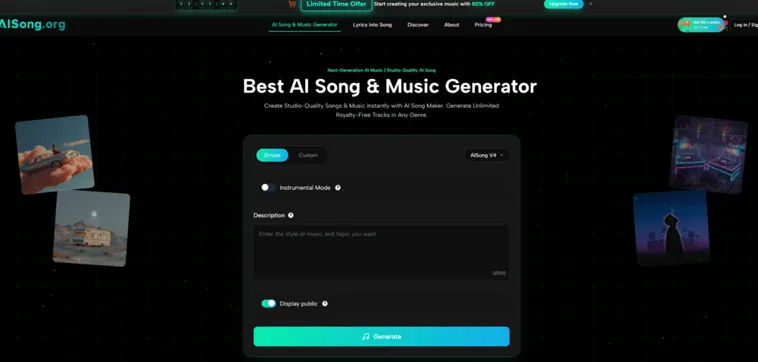
AI Song Maker sits at #1 because it matches how most creators actually work: you need something usable quickly, you want a few options, and you don’t want the last 10% of the project to take 90% of the time.
Why it’s the most creator-aligned starting point
- It supports a clean pipeline: brief → multiple drafts → selection → export.
- It’s easy to treat outputs as drafts and iterate without drama.
- It fits both background scoring needs and lighter song-style creation.
Where it fits best
- Voiceover beds for YouTube, podcasts, tutorials, and explainers
- Intros/outros/stingers for consistent channel branding
- Ads, demos, and short-form edits where speed matter.
What to expect (realistically)
- Prompt quality matters, and small changes can shift results.
- Multiple generations are normal; batching 3–5 candidates saves time.
2. Suno — Best for Foreground Tracks with “Song Identity”
If you want music that feels like a complete song—hook-forward, vocal-forward, shareable—Suno is still one of the most practical options in 2026.
Best use cases
- Campaign songs, chorus-driven social content, memeable hooks
- Tracks where vocals and structure are central
- Rapid creative exploration across genres
Common tradeoffs
- Lyrics coherence can fluctuate, especially across verses.

3. SOUNDRAW — Best for Background Scoring That Behaves Under Voiceover
Many creators don’t need a “song.” They need background music that supports pacing and doesn’t compete with speech. SOUNDRAW is strong in that exact lane: predictable scoring and edit-friendly structure.
Best use cases
- Corporate videos, explainers, product walkthroughs
- Voiceover-heavy podcasts and tutorials
- Ads where clarity and timing beat novelty
Common tradeoffs
- Less suited for vocal-forward tracks.
- More “scoring tool” than “pop song generator.”

4. Udio — Best for Refinement-Driven Creators Who Iterate Toward Polish
Udio fits creators who like to generate a strong draft and then converge toward a more finished feel. The output can lean polished, and the iteration mindset is its biggest advantage.
Best use cases
- Tracks where you want more production “finish”
- Iterative workflows: generate → select → refine
- Projects that benefit from a more record-like presentation
Common tradeoffs
- Best results often come from controlled iteration, not one-shot prompts.
- For high-stakes publishing, it’s prudent to stay aware of policy and terms that may evolve.
5. AIVA — Best for Cinematic / Instrumental Composition Intent
AIVA is a valuable tool when your goal is not a pop record but a score-like atmosphere: cinematic tension, ambient movement, orchestral or classical leaning cues.
Best use cases
- Trailers, cinematic intros, documentary moods
- Game menu music, ambient beds, instrumental scoring
- Projects where “composition intent” matters more than vocals
Common tradeoffs
- Not optimized for modern vocal pop speed.
- Some creators will prefer simpler, faster generators for daily content cadence.
6. Boomy — Best for Lightweight Speed and Quick Publishing Experiments
Boomy is useful when you want low friction. It’s often less about perfect control and more about “get something quickly, test the idea, move on.”
Best use cases
- Rapid experiments and simple tracks
- Early-stage ideation when you want to try many directions
- Lightweight workflows where complexity is the enemy
Common tradeoffs
- Less fine control and polish compared to refinement-oriented tools.
- Better as an ideation lane than a precision production tool.
7. Stable Audio — Best for Text-to-Audio Experimentation and Prototyping
Stable Audio rounds out the list as a fast sandbox for ideation. It’s especially useful if you want to test many short cues quickly, then decide what’s worth polishing.
Best use cases
- Prototyping and concept exploration
- Short cues and idea validation
- Workflows where you want breadth before depth
Common tradeoffs
- Less structured “pop song” behavior by default.
- Best results often come from careful prompting and selection.
A Use-Case Map (Choose in 60 Seconds)
| Your Primary Use Case | Best First Pick | Strong Alternatives |
| Voiceover bed / background scoring | AISong | SOUNDRAW |
| Hooky vocal tracks / song identity | Suno | Udio |
| Refinement toward polished output | Udio | AISong |
| Cinematic / instrumental scoring | AIVA | AISong |
| Quick experiments / low friction | Boomy | Stable Audio |
| Rapid prototyping and ideation | Stable Audio | Boomy |
A Practical “Two-Prompt Test” That Works Across All 7
If you want to choose without guessing, run two prompts per tool:
Prompt A: Background scoring
- Mood + tempo lane + minimal instrumentation
- Add “under voiceover” and “loop-friendly”
Prompt B: Foreground track
- Genre + hook intent + vocal style (if needed)
- Add “clear chorus lift” and “memorable motif”
Generate 3–5 candidates, drop the best one under real footage, and judge only one thing: time-to-usable audio.
A grounded closing perspective
In 2026, the best AI music generator is the one that fits your job-to-be-done. AISong stays the most broadly useful starting point because it supports the workflow most creators live in: produce drafts quickly, select based on fit, export, and ship. From there, Suno and Udio cover foreground song creation and refinement. SOUNDRAW anchors the scoring lane. AIVA serves cinematic intent. Boomy and Stable Audio round out experimentation and prototyping when speed matters more than precision.